
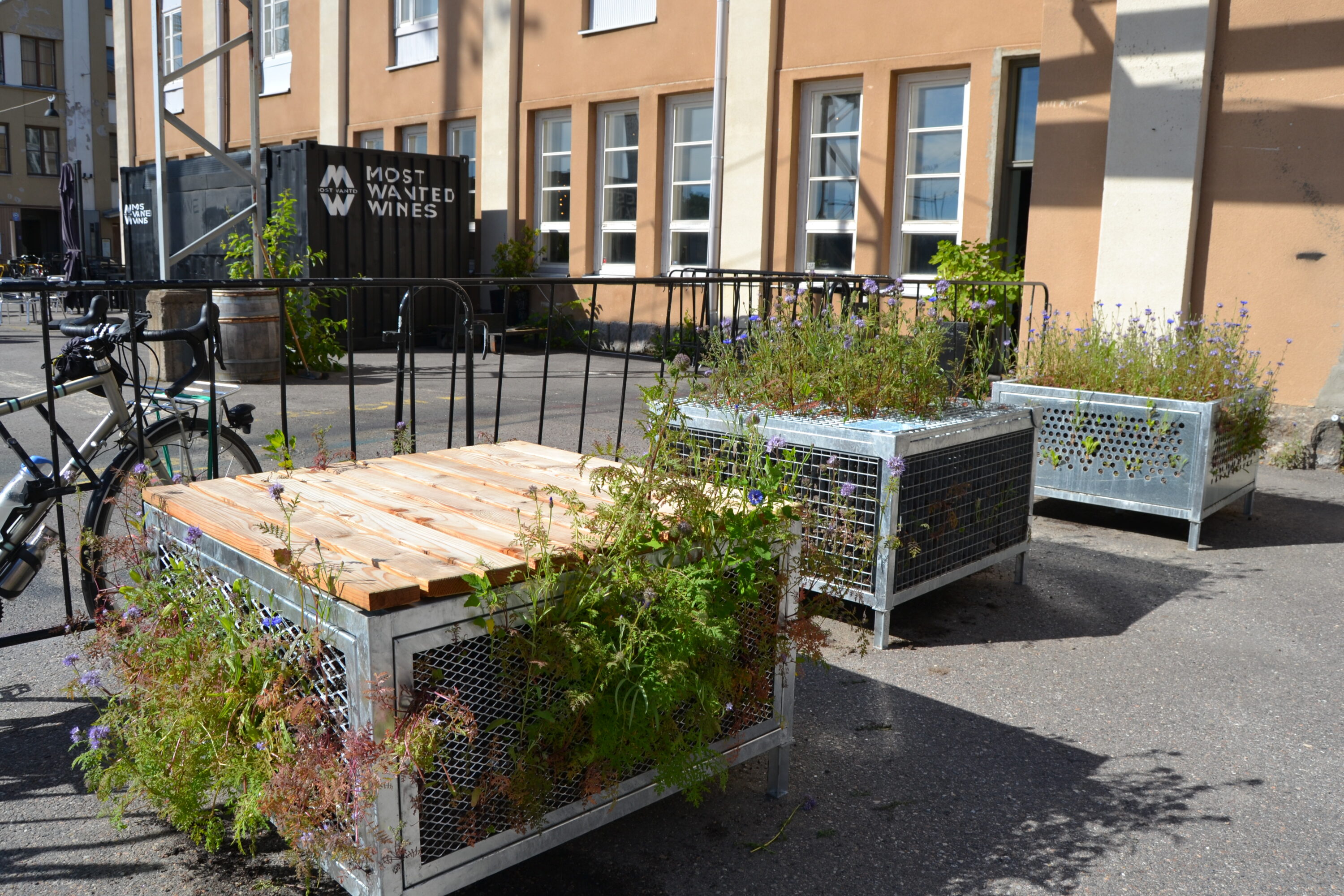
Plants rescued from a “waste garden” established in July 2024 found a new home in Suvilahti. The goal of the project is to promote increased greenery in cities.
Discarded plants constantly generate waste that could be utilized in many different ways. Among other things, this is the focus of the PilotGreen project, which is developing new ways to increase vegetation in urban environments. As part of the project, the Hukkapuisto park in Suvilahti, Helsinki, has been created, where the plants are utilized as part of a dense urban area.
BlokGarden is responsible for the park’s implementation, and Forum Virium Helsinki is coordinating the pilot. Project planner Santeri Kero from Forum Virium explains that Suvilahti is ideally suited for Hukkapuisto due to its location. “The plants and structures are completely portable and a good fit for Suvilahti, as there are plenty of events here,” he notes.
The Use of Plants and Biodiversity
The PilotGreen project, partially funded by the European Union, aims to develop new types of solutions in collaboration with companies, cities, and city residents. The purpose of the “Waste Park” is not only to provide plants with a useful new purpose but also to demonstrate that even imperfect plants can thrive in the right environment. The plants were mainly sourced from surplus stock at stores and nurseries. In addition to planting them, local residents take care of maintaining the plants.
“The plants in the area can be used not only to green up paved areas but also, for example, during festivals,” Kero says, noting that the goal is to keep the plants in the area through the winter and determine how they fare in Finnish weather conditions.
A planting event for Hukkapuisto in Suvilahti was held with local residents on July 10, 2024. As part of the project, in addition to Suvilahti, there is also a Hukkapuisto in Lahti implemented by LAB University of Applied Sciences.
“The project has also sparked interest in establishing other Hukkapuisto parks in Finland,” Kero notes.

The Luontoasema pilot project is testing the use of topsoil
Another pilot project is also underway in Suvilahti, demonstrating a way to integrate local nature and biodiversity into the urban environment, particularly near construction sites. In the experiment, called “Nature Station,” topsoil from construction sites is stored in box-like structures near the construction site. This preserves the area’s natural values better than leaving the sites completely exposed. In addition, the pilot project is investigating how seeds in the soil sprout through the structures. Currently, the functionality of the structure is being tested on a smaller scale, using three modules.
“We hope that companies and cities will be inspired to scale up the idea of utilizing waste plants in urban areas.”
— Santeri Kero, Project Planner, Forum Virium Helsinki
The pilot projects in Suvilahti are testing the practical feasibility of these concepts so that they can later be scaled up on a larger scale.
“We hope that, based on our experiments, companies and cities will be inspired to carry out more similar experiments and scale up the idea of utilizing waste crops in cities,” says Kero.
Read more Forum Virium’s greenery projects in the Kalasatama and Suvilahti areas.